Sonic Boom Monster Madness
Requirements
Description
The Monster Madness set is the final set of the Sonic Boom series for now. It contains a wide variety of Monster specific cards specifically designed to overpower your opponent. With 18 cards per pack, you are certain to get a card that will help you to defeat your enemies. Monsters are a specific set of species within Sonic Boom which are particularly strong. They are not considered to be Aliens, which are a different strong species. Please read the rules below before you start your Sonic Boom Adventure!
Rulebook:
Description Sonic Boom is a two-player card game. The objective of the game is to defeat your opponent either by reducing their health points from 100 to zero, or by reducing the remaining cards in their deck to zero. When a player cannot draw a card at the start of the turn, they lose. Throughout the game, both players will use many different sorcery spells, and creatures to outmaneuver their opponents. Tactics in decks will vary greatly depending on each player’s preferences. As of this printing, there are currently 135 different cards in the game. Collecting all cards will provide an advantage your opponents do not have. Creatures vary in strength and abilities, and each may prove to have their own unique advantages. Finding which card to use in a particular situation is part of the challenge.
Components In preparation for the game, players will need to obtain 30 cards. 25 of the cards must be either a sorcery spell card, or a creature card. The remaining five cards must be Chaos cards. In addition to the 30 cards, players must also have at least one dice. It is recommended to also bring a notepad for the game. This will help keep track of total health points remaining for each player, in addition to keeping track of creature’s current stats.
Startup Before the game starts, players must roll a dice to see who will start. A coin toss may occur if one is available. Decks must be shuffled completely. At the beginning of the game, each player must draw 3 cards. When a player starts their own turn from that point, they will draw an additional card.
Cards The player’s deck is one of the most important features of the game. Each card can either be a Sorcery Spell, Creature, Planet, or Chaos card. Sorcery Spell card activation is dictated upon the description printed on the card. The majority of the time this will occur on the owner’s turn. Creature cards can either be a monster, human, animal, or alien. This category will be printed on the card in the lower right. Creatures may have effects- so it is very important to read the description printed on the cards. Chaos cards must be activated as soon as they are drawn. If an effect cannot be redeemed, the card must be sent out of play. Cards can either be set in shield, attack, passive, or controlled stance. This is dictated by the position of the card.
Examples Shown below:
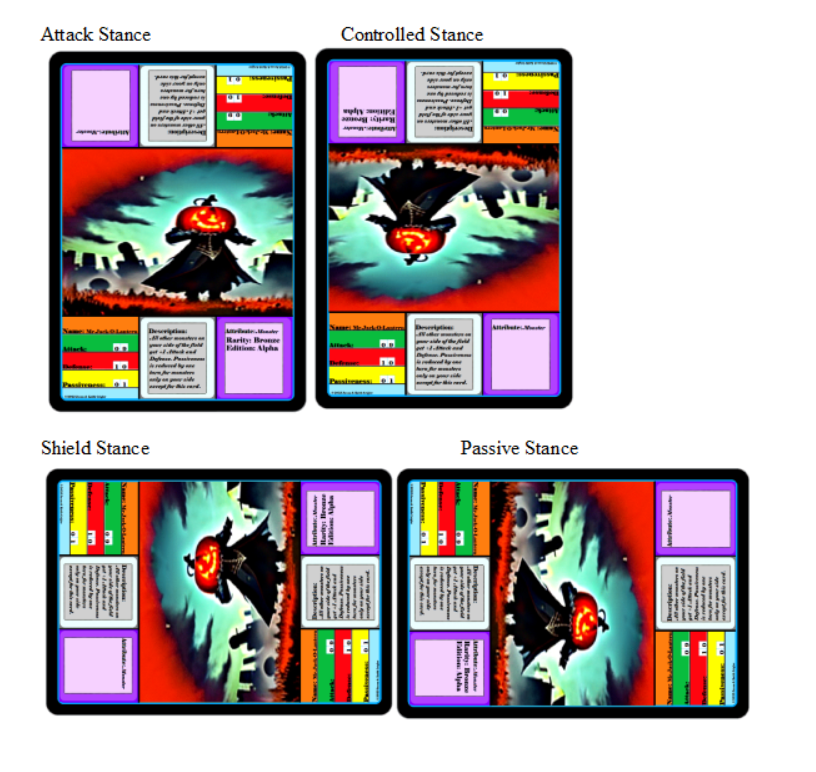
Creatures must go through their passive stance before proceeding into the attack stance. One passive turn is completed at the end of the owner’s turn. No duplicates of a card can be used except for planet cards- which you may have up to three total planets of any type. Planet cards are special – by allowing the player to control the terrain. Only one Planet card may be in play at a time, and this Planet affects both players’ zones.
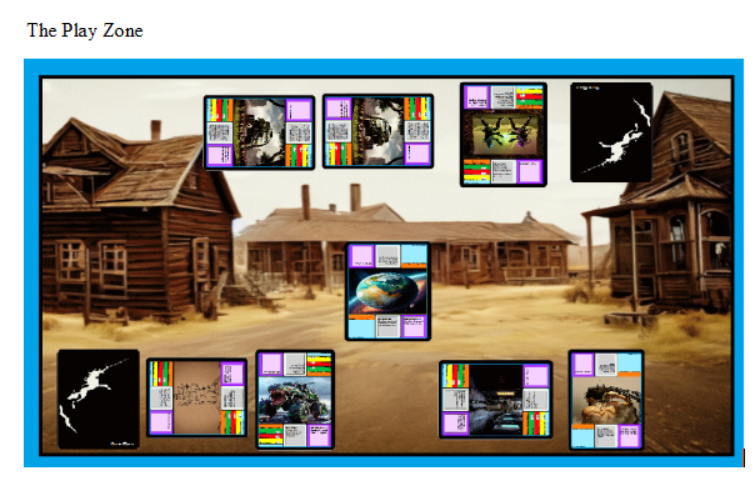
The Play Zone
Below is an example of a play zone mat. The world/planet card is placed in the center of the game mat. Up to three creatures can be play on both sides. The sorcery spell cards are placed on the right.
Attacking
A player must first select a card they control to attack one opponent creature at a time (unless otherwise directed by the card). When two creatures fight one another- the creature with the highest remaining attack wins. If both creatures are in attack, the difference is directed at the player who has the weaker card. If the active turns hosts creature is still alive- it can still attack another creature in play with its remaining attack that turn. If a creature is reduced to 0 attack, or defense- it is removed from play. After every attack has commenced, the active player can choose to return creatures to their hand. If a card is returned to a hand, the attack and defense still remain on that card. If a card that was in attack stance has attacked plus remains on the field, it is changed to passive stance. Finally, if a card survives its passive stance count again without being changed to defense stance, or returned to the hand- it can regain up to half of the attack stance points (rounding up). Remember- you can only hold a total of five (5) cards in your hand at a time. If you have more than that by the end of your turn, you have to discard one. Just because a monster is in attack stance does not mean they have to attack.
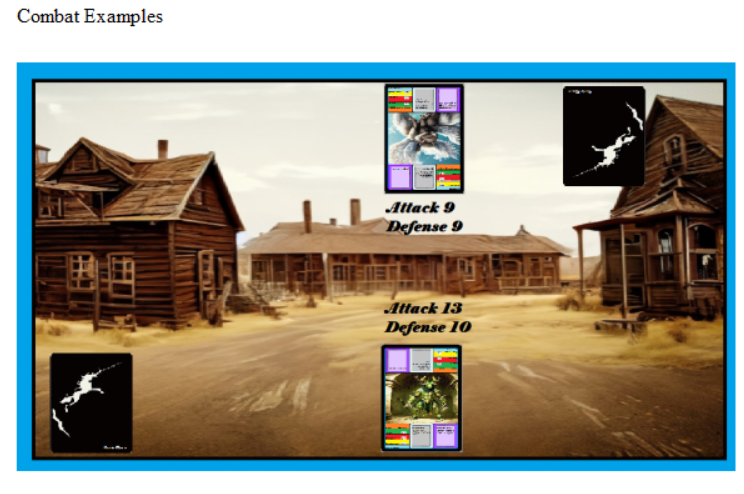
Combat Examples
Example 1
Your Minotaur attacks with 13. Opponent’s Ragged Flying Fox has an attack of 9. Minotaur would be reduced to 4 attack, and the opponent would receive 4 damage. Minotaur would go into passive stance, or return to owner’s hand (if the player would wants Minotaur to retreat).
Example 2
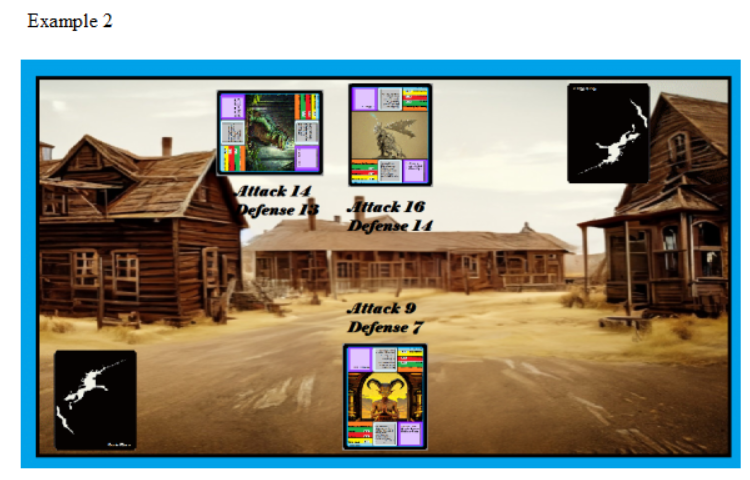
Your Demonic Alien has taken control of Alien Vanguard. In this situation Alien Vanguard is under your influence! You may use it until it is removed from play, or if Demonic Alien is removed from play. Notice how the Alien Vanguard is facing your direction signifying it is under your control. With this in mind the following might occur.
Alien Vanguard attacks Giant Lizard. Since Giant Lizard is the last card in play, the remaining damage of 2 can be directed at the enemy player. Next Demonic Alien would attack performing an additional 9 damage totaling an 11.
Alien Vanguard’s attack would not be reduced, but both Alien Vanguard and Demonic Alien would have to switch to passive stance after the turn ends.
Example 3
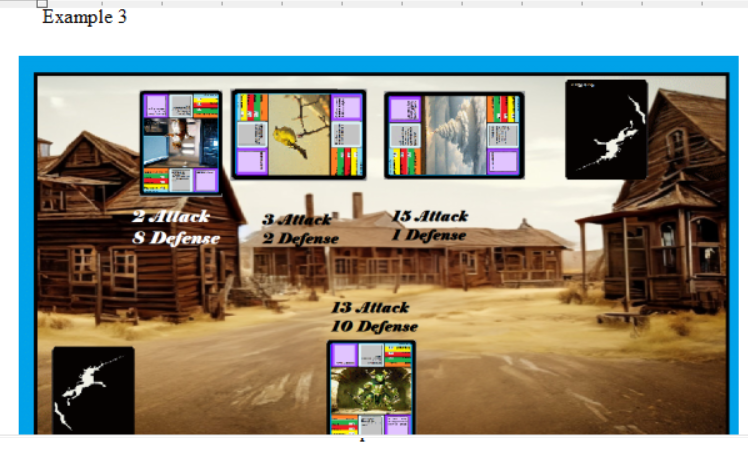
Your Minotaur attacks with 13. Opponent attack monster with attack of 2- 11 damage to opponent. Minotaur has 11 strength remaining. Opponent passive monster with attack of 3- 8 damage to opponent. Minotaur has 8 strength remaining Opponent Defensive monster with defense of 1- No damage done originally. Minotaur has 7 strength remaining
Minotaur can use remaining strength to damage opponent for 7 Health points.
Twenty Six (26) damage would go to the opponent. Passive uses attack points.
Since Minotaur attacked a defense stance card, Minotaur attack remains at eight (8), and switches to passive after turn end (if not returned to owner’s hand). All opponent cards would have been removed from play. If Minotaur’s attack had fallen below seven (7), he would be allowed to restore his attack up to that amount if he survived his next Passive turns.
Components
| Component | Quantity | Photo |
|---|---|---|
| {{item.name}} | {{item.quantity}} |
|
Vitals
| Average Rating | 0 reviews |
|---|---|
| Publish Date | August 07, 2024 |
| Edition | Unlimited |
| Department | Games |
| Tags | {{tag.properties.name}} |
See It In Action
Ratings and Reviews
{{review.properties.review|truncate(review.stash('truncate')||200)}}