Flibble
Requirements
Description
A light hearted game where you create new words that you believe are a good fit for a given meaning. Everyone must then try to work out which new words should be linked to which meanings. The most successful players each round get a Flibble cube. The first player to get four cubes wins!
Setup
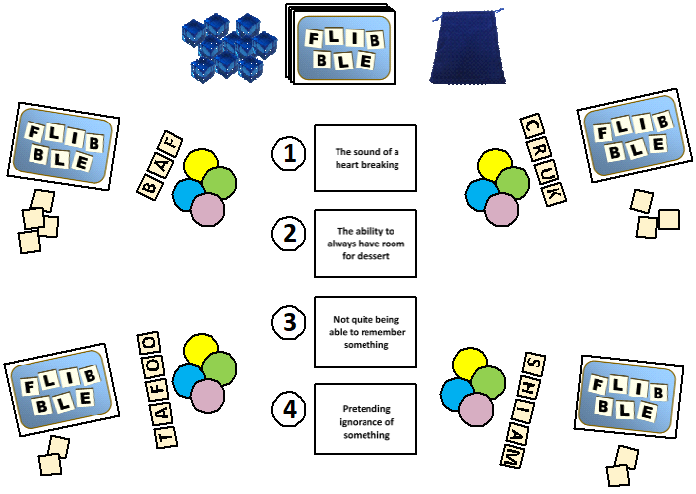
Each player takes a set of coloured tokens from 1 to the number of players—for 5 players each would take numbers from 1 to 5. Place the same numbers in white tokens in the center of the table. Deal 2 Flibble cards to each player, and place the deck at one side within reach. Each player draws 7 letters from the Letter bag. If any player has one or less vowel, or one of less consonant, they may exchange for a new set of 7 letters.
Each Round
Each player looks at the definitions on their Flibble cards and chooses one, and then uses some of their letters to make a word that fits that definition. They place their Flibble card face down in the centre of the table, and lay out their word to face the other players. The chosen Flibble cards are then shuffled and laid out against the white number tokens—one for each. The definitions on the Flibble cards should then be read out, and each player should then in turn pronounce their word—without any particular emphasis or expression. Each player now plays out their number tokens face down against each word—linking that word to the definition that they believe it matches. Play the number matching your own word down against your own word first.
Word Restrictions
No existing words, or parts of words, can be used where their meaning in any way relates to the Flibble card definition. For example, if the Flibble card mentions vegetables, then including something like ‘weed’ as part of the word would be a violation—as there is a plant link. No prefixes or suffixes can be used that would associate the word with the definition. For example, using the suffix ‘ing’ implies a verb. Using the prefix ‘re’ (or even ‘ri’ if pronounced as ‘re’) for a definition that concerns redoing something would also be a violation. If a violation occurs (which is only usually clear when scoring), then that player is disqualified for that round as is treated as if they got the lowest possible score. If at least one player got the word and definition link incorrect, then it should usually be allowed. If there is contention, then just democratically decide as a group. It is usually fairly clear if something is amiss, as the idea is to create completely new words.
Round Scoring
Each player in turn reveals which is the correct definition for their word. They turn over the number tokens, and return the token for each correct answer to the owning player. Once every player has done this, each player should have all of their tokens that were against the correct word, and still have tokens of other players that were incorrect. Each player’s score for the round is then the count of their own tokens minus the count of the others. So in 4 player, if you allocate all of your tokens correctly, and everyone else correctly determines your word, then you will end up with all 4 of your tokens back, and no others. You would score 4. While if you got all the others wrong, and all three players got yours wrong as well, you will end up with just 1 of your tokens, and 3 other tokens. You would score –2. The highest scorers for each round receive one Flibble cube.
End of Round
All number tokens are now returned to their respective player. The used Flibble cards are discarded. Each player draws a new Flibble card so that they again have 2 Flibble cards. Each player returns the letters they used to the letter bag, and then draws new letters so that they again have 7 letters. If any player has one or less vowel, or one of less consonant, they may exchange for a new set of 7 letters.
Game End
When one or more players have accumulated 4 Flibble cubes, they are the declared the winner.
Components
| Component | Quantity | Photo |
|---|---|---|
| {{item.name}} | {{item.quantity}} |
|
Vitals
| Average Rating | 0 reviews |
|---|---|
| Publish Date | June 05, 2022 |
| Edition | First |
| Department | Games |
| Tags | {{tag.properties.name}} |
Why buy this?
- Everyone plays at once - no down time.
- Fun seeing how different people relate words to meanings.
- Easy to learn. Quick to play. Very replayable.
Related Games
Downloads
Finite Monkey

Notes
- This game contains a premium upgrade called UV Coating that makes the printed components more durable.
See It In Action
Ratings and Reviews
{{review.properties.review|truncate(review.stash('truncate')||200)}}