River Bankers
Requirements
Description
Summary
Four riverbank animals — a beaver, an otter, a muskrat and a mink — are all building along the same stretch of river. Logs, stones and reeds come floating down it, and you bid against each other for them.
You bid using your workers. Everything you do costs fish, and the player who has spent the fewest fish takes the next turn.
Play the whole game free in your browser:

The Auction
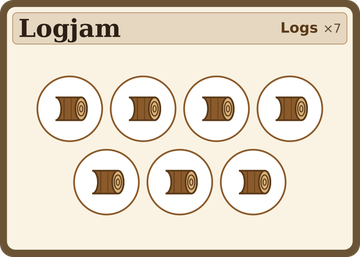
A material card shows a row of item icons, and no price. What it costs you depends on how far down the river it has drifted.
When a card comes up for auction, every player secretly decides how many items they want, and then everyone reveals at the same time. You pay for every worker you bid, whether or not you end up winning anything.
Add up all the bids and compare that to the number of icons on the card:
- If the bids fit — everyone gets exactly what they asked for. Put a worker on each icon you claimed.
- If the bids don't fit — the river is jammed. Work out how many workers were bid over the card's capacity, and subtract that number from everyone's bid. That's what each player actually gets. Anything still unclaimed drifts one space downstream, where it will cost more next time.
- If the jam is bad enough that nobody would get anything — the player who called the auction still takes one item.
You can only bid as many workers as you have in front of you, so bids stay small and there is no money to count or change to make.
Turn Order
There are no rounds. Every action moves your pawn forward on a shared 60-space fish track, and whoever is farthest back goes next. If you're still farthest back after your turn, you go again.
That means a cheap action can give you two or three turns in a row, and an expensive one hands the table a long stretch of turns without you. Choosing when to spend is most of the game.
Your Turn: One Action
| Action | Cost | What you do |
|---|---|---|
| Pull | 2–4 fish | Pull a card out of the Headwaters and auction it right away, at a cheaper rate than the river. |
| Swim | 1 fish | Auction a card already in the river that still has open icons. |
| Flush | 5 fish | Clear out the Headwaters, turn over three new cards, shuffle the old ones back in — then auction one of the new cards for free. |
| Invent | 2–5 fish | Pick a number from 2 to 5, draw that many structure cards, then discard that many from your hand. |
| Build | printed | Take workers off material cards and use them to build a structure from your hand. |
Pull, Swim and Flush all start an auction, and if you start one you have to bid at least one worker yourself.
The Price Depends On Where The Card Is
Each worker you bid costs you fish based on where the card is sitting:
| Where the card sits | Cost per worker you bid |
|---|---|
| Headwaters | 1 fish |
| River 1 | 2 fish |
| River 2 | 3 fish |
| River 3 | 4 fish |
| River 4 | 5 fish |
A card nobody clears out keeps drifting further down the river and gets more expensive each time. Once it goes past River 4 it lands on the shoreline and can't be auctioned again. So waiting for a card to get cheap doesn't work — but neither does grabbing everything early.
Building
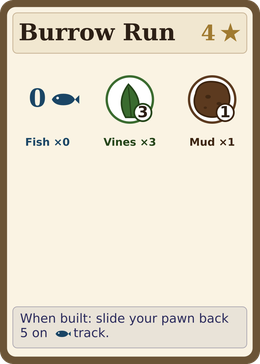
Your workers are both your bids and your storage. Once a worker is sitting on a material card, it stays there until you use it.
To Build, pay the fish cost on the structure card, take your workers back off material cards of the right types, and put the structure face-up in front of you. It's worth victory points at the end of the game.
Most structures also do something for you while they're in play — make a material cheaper, give you another kind of action, do something once when you build it, or score extra at the end depending on how things turned out. There are 49 structures in the deck, and you only hold three cards at a time.
The End Of The Game
The fish track has a finish line at 90 fish, which is a lap of the track plus thirty. As soon as one of your actions takes you past it, you finish that action and stop playing. Everyone else keeps going.
When everyone has finished, each player gets one last build. Then add up the victory points on your structures, plus 1 point for each matching pair of workers you left behind on the river. Highest total wins.
Optional: Play The Animals Differently
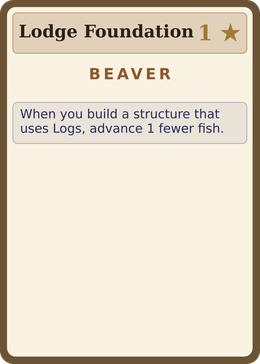
Each animal has its own set of three starter cards. At setup, everyone picks one and it starts the game already built, for free.
One card in each set makes that animal's material cheaper — logs for the beaver, reeds for the otter, mud for the muskrat, clay for the mink. Take it if you want to specialize, or pick one of the other two instead. Stones and vines aren't tied to any animal, so everyone competes for those.
Leave the starter cards in the box and all four animals play the same. That's the easier way to learn the game.
Components
| Component | Quantity | Photo |
|---|---|---|
| {{item.name}} | {{item.quantity}} |
|
Vitals
| Average Rating | 0 reviews |
|---|---|
| Publish Date | June 20, 2026 |
| Edition | First |
| Department | Games |
| Tags | {{tag.properties.name}} |
| More Info | River Bankers web site |

See It In Action
Ratings and Reviews
{{review.properties.review|truncate(review.stash('truncate')||200)}}